
The landscape of American healthcare is undergoing a seismic shift in 2026. For Doctor of Optometry (OD) students, the transition from clinical theory to chair-side practice involves more than just mastering the phoropter. It requires a robust understanding of medical jurisprudence—the intersection of law and healthcare. As scope-of-practice laws expand across states like California and New York, the legal accountability of optometrists has never been higher.
The Foundations of Medical Jurisprudence in Eye Care
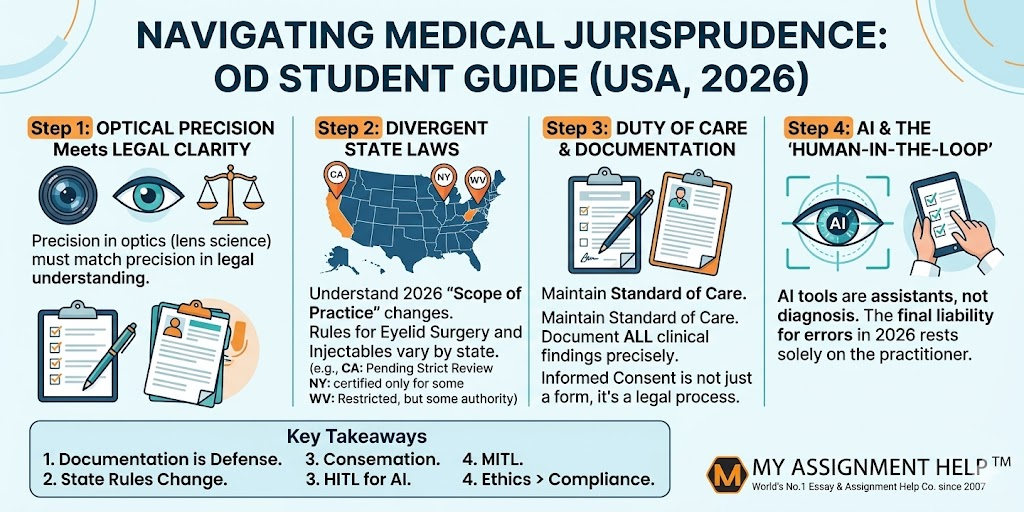
In the United States, optometry is regulated at the state level, but federal mandates like HIPAA and the 2026 AI-transparency acts create a complex web of compliance. Jurisprudence isn’t just about avoiding lawsuits; it’s about upholding the “Standard of Care.” This legal term refers to the level of care and skill that is expected of a reasonably prudent practitioner under similar circumstances.
For a student, this means every clinical decision must be documented with the precision of a legal brief. Failure to diagnose a retinal detachment or a mismanaged glaucoma follow-up isn’t just a clinical error—it’s a potential breach of contract with the patient.


The Rising Stakes: Liability and the 2026 Malpractice Landscape
Recent data from the National Practitioner Data Bank (NPDB) indicates that while optometric malpractice claims remain lower than surgical specialties, the severity of awards is increasing. In 2025 and 2026, several US jurisdictions saw record verdicts in cases involving delayed diagnosis of systemic conditions manifested in the eye.
Navigating these academic requirements can be overwhelming. As students balance clinical rotations with high-stakes testing, many find that professional support for assignment writing USA helps them articulate complex medical-legal theories in their coursework without sacrificing clinical hours. This allows future ODs to focus on practical skills while ensuring their theoretical submissions meet the rigorous standards of American medical ethics.
Ethical Dilemmas: Beyond the Law
Ethics and law often overlap, but they are not identical. An action can be legal but ethically questionable. In optometry, common dilemmas include:
- Informed Consent: Does the patient truly understand the risks of a new contact lens modality or a surgical co-management plan?
- Professional Boundaries: Managing referrals when a patient refuses to see an ophthalmologist despite a clear need for surgery.
- Conflict of Interest: Balancing the commercial side of a practice (selling frames) with the clinical necessity of the prescription.
Students are increasingly tasked with writing comprehensive ethics boards. If you find yourself struggling with the nuanced language required for these submissions, seeking specialized law essay help can provide the structural clarity needed to navigate jurisprudence assignments effectively.
2026 Regulatory Trends: AI and Tele-Optometry
The integration of AI-driven diagnostic tools has introduced a new “Duty of Care.” If an AI algorithm misses a pathology, who is liable? The 2026 US regulatory framework places the final responsibility on the licensed practitioner. This “Human-in-the-Loop” requirement means students must learn to audit AI outputs critically.
Key Takeaways for OD Students
- Standard of Care is Dynamic: It changes as technology and state laws evolve.
- Documentation is Defense: If it wasn’t written down, it didn’t happen in the eyes of the law.
- Ethics > Compliance: Aim to exceed the legal minimum to ensure patient trust and safety.
- Stay Informed: Follow the American Optometric Association (AOA) updates on 2026 legislative shifts.
FAQ Section
Q1: What is the most common cause of malpractice in US optometry?
Historically, the failure to diagnose (specifically tumors or retinal issues) remains the leading cause of litigation in American eye care.
Q2: Does HIPAA apply to optometry students during externships?
Yes. Any student handling Protected Health Information (PHI) in a US clinical setting is legally bound by HIPAA regulations.
Q3: How has AI changed optometry liability in 2026?
Current 2026 laws dictate that the optometrist, not the software developer, is responsible for any diagnostic errors made when using AI-assisted tools.
Author Bio
Dr. Sarah Jenkins, JD/OD Liaison Sarah is a senior content strategist at MyAssignmentHelp, specializing in the intersection of healthcare law and academic success. With over a decade of experience in medical jurisprudence, she assists students in the USA and UK in mastering the complexities of professional ethics and liability through high-utility educational resources.
Data-Driven Reference List (2025-2026 Focus)
- National Practitioner Data Bank (NPDB) – 2025 Annual Malpractice Report: Optometric Trends.
- American Optometric Association (AOA) – 2026 Ethics and Values Committee Guidelines.
- Journal of Medical Jurisprudence – The Impact of Generative AI on Standard of Care in Primary Eye Care (Vol. 14, 2026).
- U.S. Department of Health & Human Services (HHS) – HIPAA Compliance for 2026 Digital Health Transitions.